

Forecast for Central Texas

 0%
0% 0%0%0%
 0%
0%
Reports from LCRA’s Hydromet
Rainfall summaryTemperature summary
Humidity summary
Bob's Blog on Central Texas Weather
Fall-Like Temperatures this Weekend. Warmer Readings Returning Next Week
The first strong cold front of autumn moved across the area late Thursday night into early Friday morning, bringing gusty winds and much cooler temperatures! After wearing shorts for the past few months, many folks are now reaching for a light jacket. Cool, fall-like temperatures will be in place through the weekend and early next week, but warmer temperatures will be returning for the second half of next week.
A large area of moderate to heavy rain developed across parts of West Texas, the Edwards Plateau, and the western Hill Country region Thursday night into early Friday morning when the cold front met up significant moisture off the Pacific and the Gulf. LCRA’s Hydromet and Doppler radar estimates show widespread totals of 1.5 to 4 inches falling over the area from Rocksprings, to Menard, Brady, and Brownwood. LCRA’s highest gauged total was 4.28 inches at a location about 15 miles to the west of Brady. There was a sharp gradient to the rain, with little to no rain falling across the eastern Hill Country, Central Texas, and the middle Texas coast.
NWS Estimate of Rain Falling Between 7am Thursday and 7 am Friday:
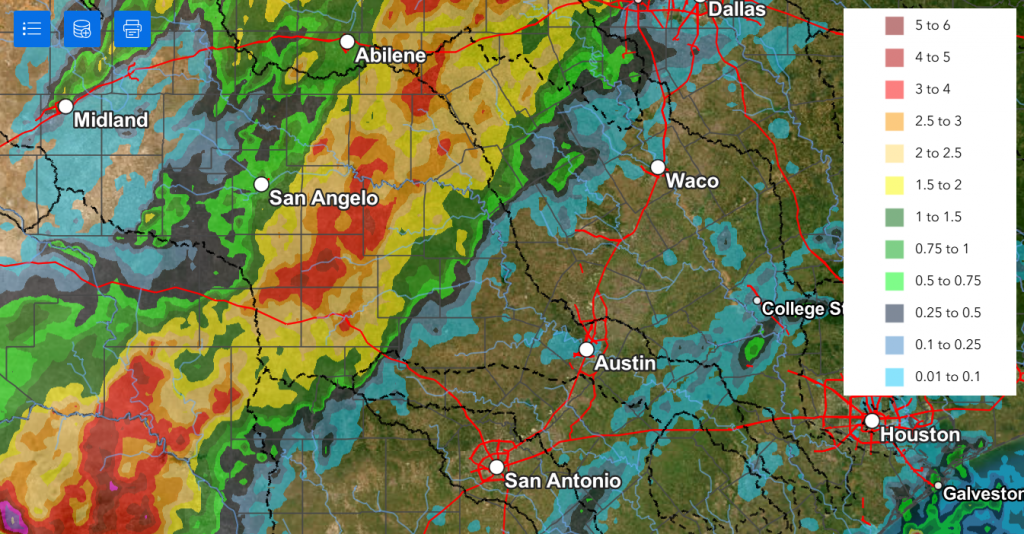
Data courtesy NWS West Gulf River Forecast Center
The strong cold front has moved off the middle Texas coast, and a large dome of Canadian high pressure is beginning to settle into Texas from the southern Rockies. A tight pressure gradient behind the front is expected to keep the winds strong and gusty through Friday night.
- Forecasts call for sustained winds of 15-25 mph with occasional gusts to 40/45 mph through late Friday afternoon
- Winds of 10-20 mph, with occasional gusts to 40 mph are predicted Friday night into early Saturday morning
- Saturday’s wind is forecast to be in the range of 10-15 mph, with occasional gusts to 30 mph through the morning
- Wind speeds should decrease to just 5-10 mph Saturday night through Sunday
The clouds are forecast to slowly decrease with the sky becoming mostly sunny Friday afternoon. This will be followed by a clear sky Friday night and this weekend.
Much cooler temperatures will be the most notable feature for the weekend. The nights will be chilly with lows in the 40s and 50s. The coldest period is expected to be Saturday night into Sunday morning. Some low valleys across the Hill Country could see readings dip into the mid and upper 30s.
- High temperatures Friday will range from the low 60s across the northern Hill Country, to the low 70s across the coastal plains
- High temperatures Saturday are forecast to be in the low and mid-60s across the Hill Country and in the upper 60s at most other locations
- High temperatures Sunday are predicted to generally be near 70-72 degrees
- Low temperatures Saturday morning are forecast to be near 40-42 degrees across the Hill Country, in the upper 40s across Central Texas, and in the low 50s across the coastal plains
- Low temperatures Sunday morning are predicted to be in the low 40s across the Hill Country, the mid and upper 40s across Central Texas, and the upper 40s across the coastal zone
- Lows Monday morning are forecast to be in the mid and upper 40s across the Hill Country, near 50 degrees across Central Texas, and in the low to mid-50s across the coastal counties
The outlook for next week calls for sunny and dry weather throughout the week. A strengthening ridge of high pressure in the upper atmosphere over Texas will cause warming daytime and nighttime temperatures. High temperatures will start off the week in the mid-70s, warm to the mid-80s by Wednesday, reaching into the upper 80s Thursday and Friday. Lows early in the week will be in the 50s, rising into the 60s for the second half of the week.
Long-range forecasts are not very optimistic for rain developing anytime soon. The forecasts do point to a chance for rain possibly developing during the second half of the week of October 26th.
Tropical Weather Outlook
Weather conditions are quiet across the Gulf, Caribbean, and the tropical Atlantic. There are no systems in place which pose a threat for tropical development over the next seven days.
NOAA’s Winter Weather Outlook
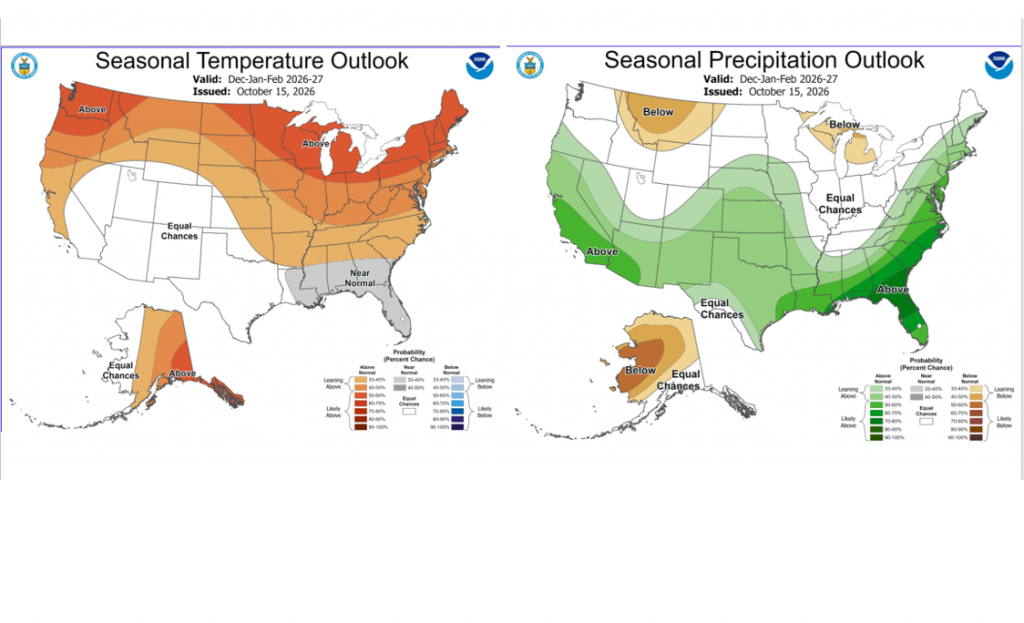
NOAA’s Climate Prediction Center released its update outlook for the upcoming winter on Thursday. The forecasters indicated this winter’s outlook would be heavily influenced by a very strong El Nino that will be in place through spring. A robust subtropical is expected to bring above normal precipitation to Texas and the southern U.S. going into spring. On the temperature side, things are not as clear. Much of Texas is expected to see numerous cloudy, wet days that may help to hold down the temperature. But there will likely be some extended sunny breaks that could produce above normal temperatures. NOAA decided to show equal chances for the temperature to average above-, below-, or near-normal.
Have a great weekend!
Bob
Turning Windy and Much Cooler Friday
Thursday is likely to be the last unseasonably warm day we’ll see for a while. Most areas will see a sunny sky this afternoon with a high temperature near 90-92 degrees.
The first strong cold front of autumn is on the way for Central and South Texas, being driven by a vigorous trough of low pressure tracking east out of the Rockies and a cold dome of high pressure sinking south out of Canada. The latest forecast guidance shows the cold front coming in faster and a bit stronger compared to forecasts from a couple of days ago.
As of late Thursday morning, the cold front had already reached the Texas Panhandle region, where temperatures had fallen into the 50s. Forecasts call for the cold front to sink southeast Thursday afternoon, reaching the northern Hill Country late this evening. The front is predicted to move through the Austin/Interstate 35 corridor shortly after midnight Thursday night, reaching the coastal plains region around sunrise Friday. A few rain showers are forecast along and immediately behind the cold front as it moves southeast. The probability for rain will be near 40 percent. Most totals should average around a tenth of an inch. Clouds will decrease Friday morning, followed by a mostly sunny sky Friday afternoon.
Very strong and gusty winds and much cooler temperatures will develop behind the cold front beginning Thursday night, continuing through Friday night, due to a tight pressure gradient. Forecasts call for sustained northerly winds to be in the range of 20-30 mph, with occasional gusts to 40/45 mph. Wind speeds are forecast to slowly decrease late Friday night into Saturday. Wind speeds on Saturday are forecast to be in the range of 10-20 mph, with occasional gusts to 30 mph. Precautions to outdoor Halloween decorations should be taken Thursday afternoon in advance of the strong winds.
Much cooler temperatures can be expected Friday through Sunday in the wake of the cold front. The coldest night of the period is expected to occur Saturday night when winds diminish across the area. It’s not out of the question some of the low Hill Country valleys could see readings reach the mid and upper 30s!
- High temperatures Friday will include the low and mid-60s across the Hill Country, the upper 60s to 70 degrees across Central Texas, and the low 70s across the coastal plains
- High temperatures Saturday and Sunday are predicted to be near 68-72 degrees
- Low temperatures Saturday morning are forecast to be in the low and mid-40s across the Hill Country, in the upper 40s across Central Texas, and in the low 50s across the coastal plains
- Low temperatures Sunday morning are predicted to be in the low 40s across the Hill Country, the mid and upper 40s across Central Texas, and the upper 40s across the coastal zone
- Lows Monday morning are forecast to be in the upper 40s across the Hill Country and Central Texas, and in the low and mid-50s across the coastal counties
Sunny, dry, and warmer weather is forecast for next week. High temperatures look to warm to the mid-80s by Wednesday.
Fire Weather Concerns
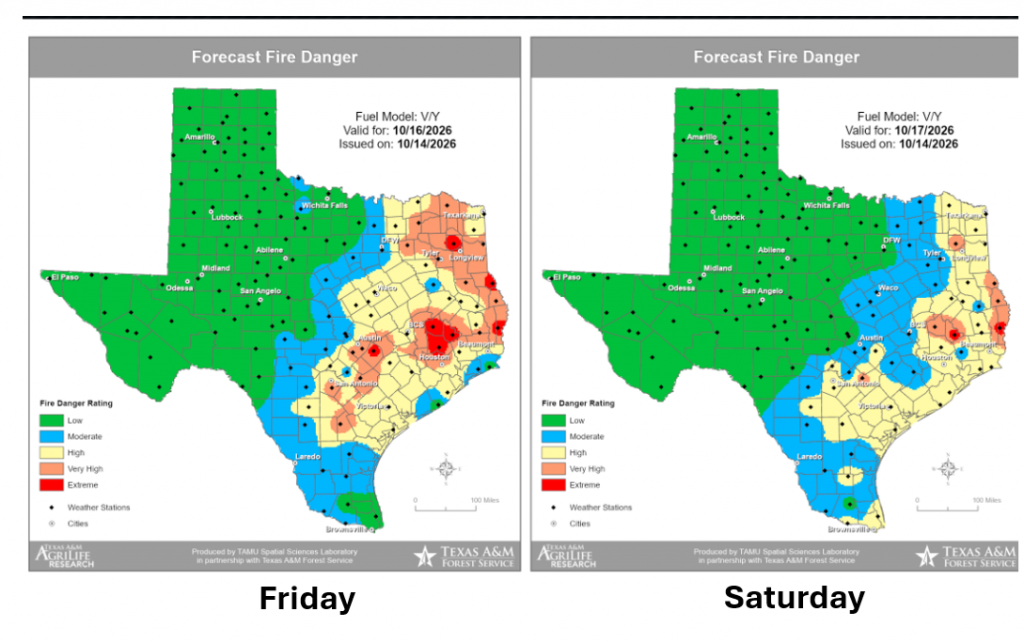
Forecasters are keeping an eye on Friday afternoon and Saturday due to elevated fire weather conditions. Strong winds are forecast both days along with low relative humidity levels. The Texas A&M Forest Service is showing high to very high fire weather danger Friday and a moderate to high fire danger Saturday.
Bob
Warm this Week. A Strong Cold Front to Bring Fall-Like Weather this Weekend
Warm, humid, summer-like weather has returned this week thanks to a strengthening flow off the Gulf. However, cooler, fall-like weather conditions look to arrive Friday and this weekend behind a strong cold front.
Monday’s weather maps showed a large ridge of high pressure in the upper atmosphere covering Texas, the south- central U.S., and the Gulf, keeping our weather warm and somewhat stable. Out west, a large trough of low pressure was pushing inland along the West Coast. This feature is forecast to slowly move east across the Rockies late Monday through Wednesday, then merge with another trough across southern Canada late week. This merged trough will help drive the first significant cold front of the fall season south across Texas on Friday.
For Monday and Tuesday, expect a partly to mostly cloudy sky across the region. With increasing moisture levels in the lower atmosphere, scattered rain showers and a couple of isolated thunderstorms will be possible—mainly for areas along and to the east of Interstate 35. The highest probability for rain (40-50 percent) will be for the coastal region. For Central Texas, the probability for rain will be near 20-30 percent. Rain amounts each day are forecast to average less than a quarter inch.
- High temperatures Monday and Tuesday will include the upper 80s to low 90s across the Hill Country, the low and mid-90s across Central Texas, and the lower 90s across the coastal plains
- Lows Tuesday and Wednesday mornings will generally be in the low and mid-70s
For Wednesday, there will be a slight chance for scattered rain showers and thunderstorms—but this time, mainly across the Hill Country region where Pacific moisture is forecast to increase. The probability for rain will only be near 20 percent. Elsewhere, little to no rain is forecast due to a pocket of drier air spread inland off the Gulf. This drier air is expected to limit the development of showers.
- High temperatures Wednesday are predicted to be mostly in the low 90s.
Thursday’s weather is shaping up to be mostly sunny, warm, and dry as the pocket of dry air remains over the area.
- High temperatures Thursday are forecast to be near 90-92 degrees
A strong cold front is forecast to spread across Texas late Thursday into Friday morning as the two troughs mentioned earlier merge. Forecasts call for the cold front to push southeast across West and Northwest Texas Thursday night, with the front arriving in the Austin area before daybreak Friday. The front should move off the middle Texas coast by noon Friday. A few spotty rain showers may accompany the cold front, but no significant rain is forecast.
Mostly sunny, windy, and much cooler weather is predicted behind the cold front Friday through Friday night. Expect a north wind with speeds of 15-25 mph, with occasional higher gusts.
- High temperatures Friday are predicted to reach the mid-70s across the Hill Country, the upper 70s to 80 degrees across Central Texas, with low to mid-80s near the coast
- Lows Saturday morning are forecast to be in the low 50s across the Hill Country, the mid and upper 50s across Central Texas, and be near 60 degrees towards the coast
A mostly sunny to sunny sky is forecast this coming weekend in the wake of the cold front.
- High temperatures Saturday are predicted to be mid and upper 70s, warming to near 80 degrees on Sunday
- Lows Sunday morning will range from the upper 40s across the Hill Country, to the upper 50s near the coast
- Lows Monday morning will be in the upper 50s to low 60s
Looking out into next week, there will be a slight chance to a chance for rain showers Monday and Tuesday as an overrunning pattern sets up across the area. Expect a mostly cloudy to cloudy sky both days. High temperatures will be in the low 80s.
Mostly sunny and mild weather will follow next Wednesday through Friday. Expect high temperatures to be mostly in the mid-80s.
Tropical Weather Outlook
Weather conditions are quiet across the Gulf and the Caribbean Sea. There are no systems in place which pose a threat for tropical development over the next seven days.
Out across the eastern tropical Atlantic, an elongated area of low pressure centered a few hundred miles west of the Cabo Verde Islands continues to produce a large but disorganized area of showers and thunderstorms on its east side, extending toward the westernmost Cabo Verde Islands. Environmental conditions appear only marginally conducive for development of this system during the next day or so before upper-level winds become too strong for any further development on Tuesday.
NHC forecasters are giving this system just a 20 percent chance for tropical development over the next seven days.
Have a great week!
Bob
Summer-Like Heat and Humidity Returning for Next Week
Hints of autumn showed up this week as overnight temperatures dipped into the 50s and 60s. Meanwhile, afternoon readings have still been somewhat summer-like. This week’s pleasant morning temperatures resulted from significantly drier air spreading into Texas behind last weekend’s cold front. The drier air is still in place and will allow for more pleasant overnight temperatures Friday night and Saturday night. but a return of southerly breezes this weekend looks to bring back humid and sticky weather next week.
- Lows Saturday morning will include the upper 50s to low 60s across the Hill Country and the mid-60s at most other locations
- Lows Sunday morning are predicted to be in the mid and upper 60s
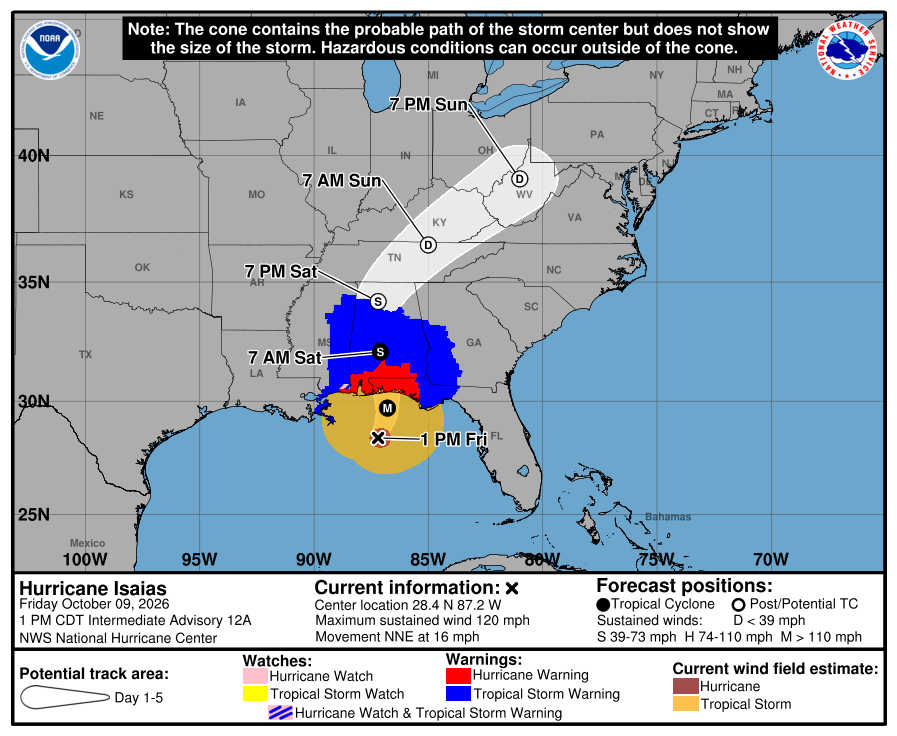
expected Major Hurricane Isaias is forecast to make landfall across the western Florida Panhandle late Friday, with the storm having little to no impact on our region’s weather. Sunny and quiet weather will be in place across Texas this weekend thanks to a broad ridge of high pressure in the upper atmosphere covering the south-central U.S. Weak east-northeasterly breezes Friday will become southerly on Saturday. Wind speeds are forecast to increase to 10-15 mph, with gusts to 25 mph on Sunday. Sunday’s onshore breezes will bring a return of moisture and higher humidity levels.
- High temperatures Friday through Monday are forecast to include the upper 80s across the Hill Country and the low 90s across Central Texas and the middle Texas coast
For next week, our weather looks to have more of a summer-like feel as warm, breezy, and humid weather holds through Thursday. A large trough of low pressure pushing inland along the West Coast this weekend is forecast to track into the southwestern U.S. Tuesday and Wednesday. In advance of the trough, a moderate flow off the Gulf is expected to bring increasing levels of moisture to much of the state.
Monday through Wednesday, expect a mostly sunny to partly cloudy sky with breezy conditions across the region. There will be a slight chance for a few scattered afternoon rain showers and thunderstorms across the coastal region on all three days. Most other locations should stay dry.
- High temperatures Tuesday and Wednesday are forecast to generally be in the low and mid-90s
The chance for scattered rain showers and thunderstorms will increase across the region Thursday when a cold front connected the southwestern trough begins to push into West Texas. Widespread rain shows and scattered thunderstorms are forecast Friday into early Saturday as the cold front pushes east across Central and East Texas. The rain is forecast to taper off from west to east next Saturday.
Noticeably cooler temperatures will follow the cold front beginning next Friday, continuing through next weekend. High temperatures are predicted to fall into the 70s, with low temperatures generally in the 50s. Much of the Hill Country will likely see lows in the upper 40s next weekend. These more fall-like temperatures are forecast to continue into the week of October 19th.
Tropical Weather Outlook
All eyes are currently on Hurricane Isaias. There are no other systems across the tropical Atlantic which pose a threat for tropical development over the next seven day.
As of 2 pm Friday, the center of Major Hurricane Isaias was located about 125 miles south of Pensacola, Florida. Maximum sustained winds were near 120 mph with higher gusts. Isaias is a category 3 hurricane on the Saffir-Simpson Hurricane Wind Scale. Fluctuations in intensity are possible through this afternoon, but Isaias is expected to be at or near major hurricane strength when it makes landfall this evening. Weakening is expected beginning Friday night after Isaias makes landfall, and the storm is likely to become post-tropical by late Saturday.
Data from NOAA and Air Force Reserve Hurricane Hunter aircraft indicate that maximum sustained winds remain near 120 mph with higher gusts. Isaias is a category 3 hurricane on the Saffir-Simpson Hurricane Wind Scale. Fluctuations in intensity will be possible through Friday afternoon, but Isaias is expected to be at or near major hurricane strength when it makes landfall Friday evening. Weakening is expected beginning Friday night after Isaias makes landfall somewhere over the western Florida Panhandle. The storm is likely to become post-tropical by late Saturday.
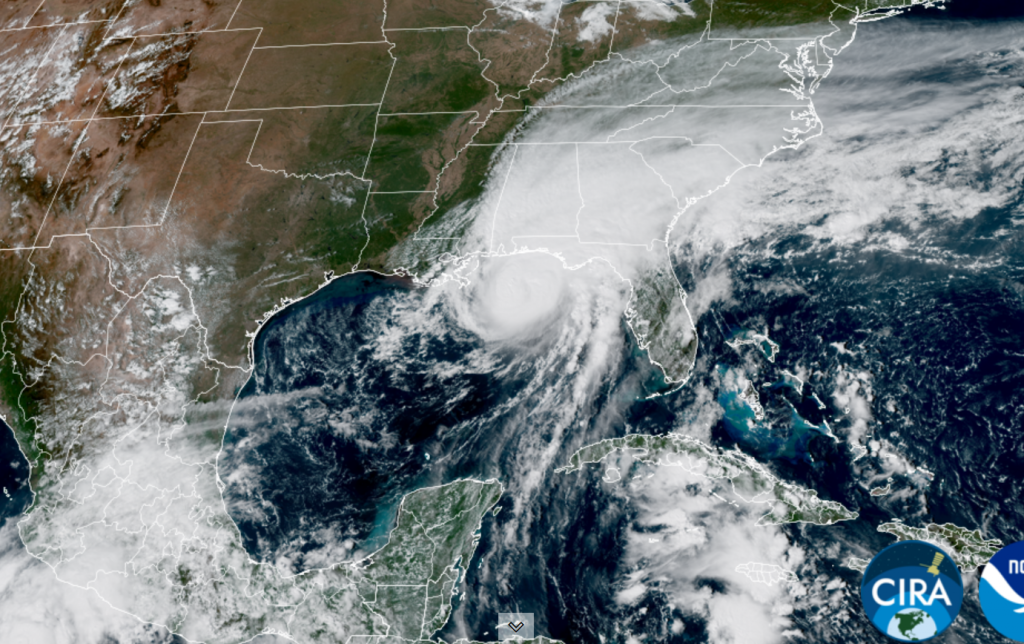
NOAA/Colorado State University/CIRA 10/09/2026 2 pm CDT
Have a great weekend!
Bob
Weather Looks to Stay Dry and Warm into Early Next Week
Gulf Low:
Satellite images and surface observations early Tuesday afternoon indicated the showers and thunderstorms over the southwestern Gulf were becoming better organized and s surface pressures were gradually falling. According to the National Hurricane Center, if these trends continue, this system will likely be upgraded to a tropical depression Tuesday afternoon or Tuesday night. (The NHC is putting the chances of tropical development at 100 percent).
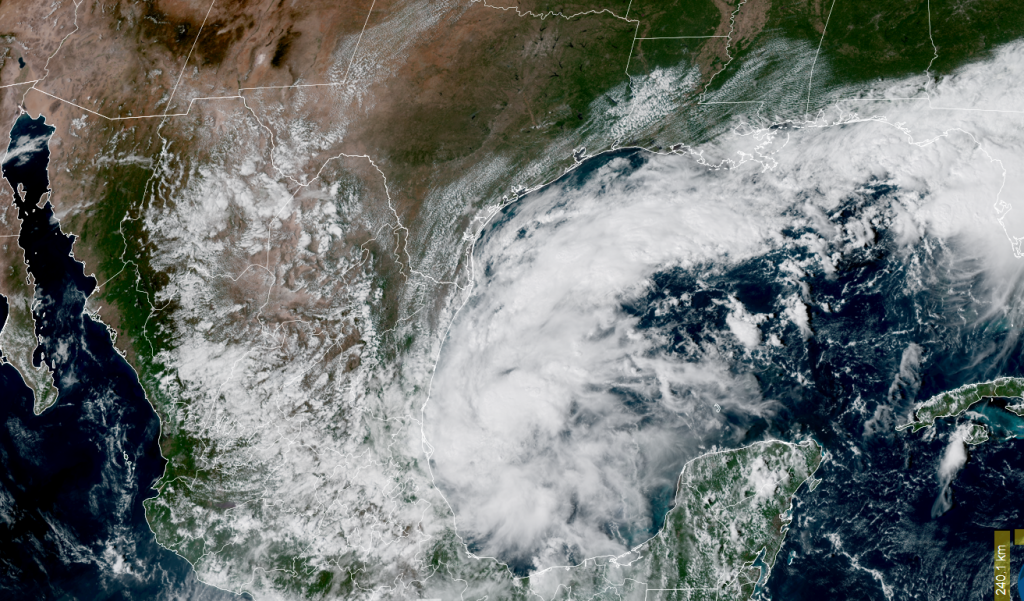
NOAA/Colorado State University 10/06/26 2:20 pm CDT
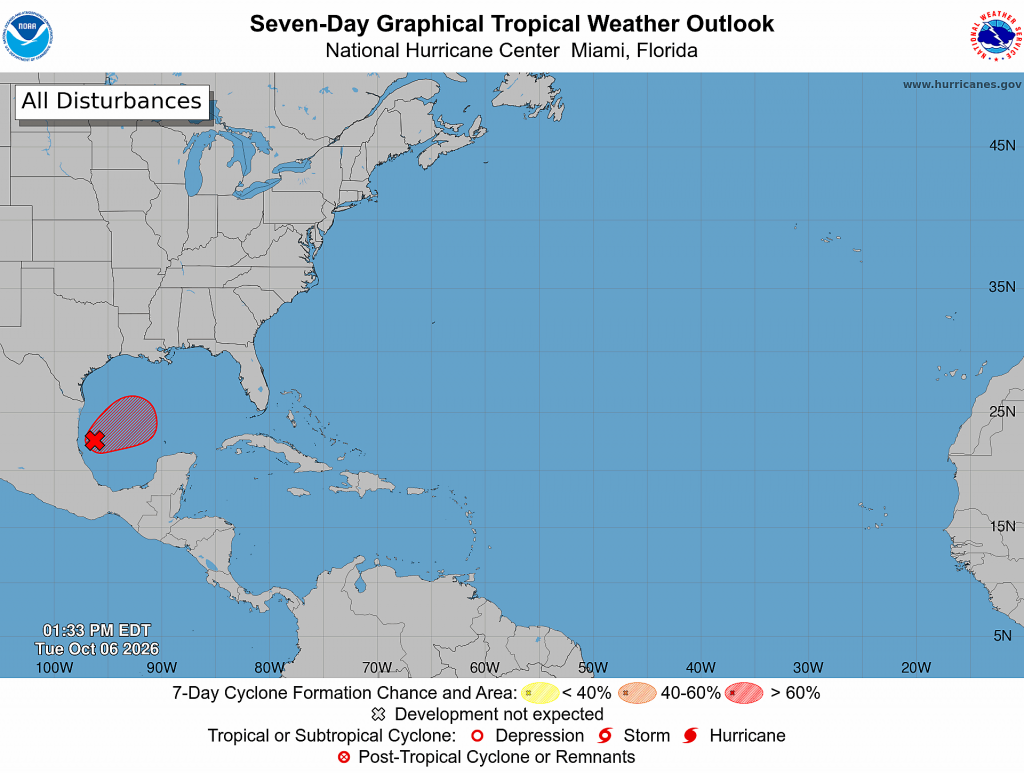
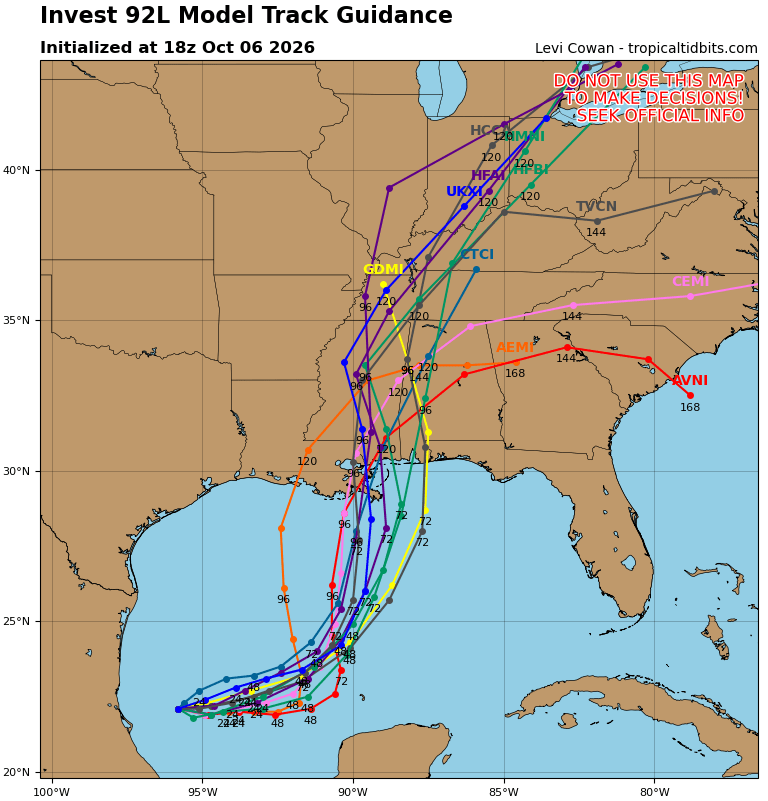
The disturbance is currently moving slowly to the east but is expected to turn to the north or northeast and track toward the northern Gulf Coast by the end of the week. This is due to a trough of low pressure dipping southeast out of Oklahoma and northeast Texas. Based on this, the tropical disturbance is not expected to have any significant impact on Texas weather. Persistent northeasterly winds along the coast will increase into late week and this will be a favorable setup for coastal flooding. Forecasted tides look to run 1-2 feet above normal by late week and minor coastal flooding will be possible at times of high tide Thursday through Saturday.
There is some disagreement on how fast the disturbance will track to the north. the slower end of the forecast guidance seems most accurate, calling for the system to drift slowly to the east for the next 24 hours before starting a more consistent motion to the north on Thursday, with the system accelerating northward Friday into Saturday.
Most of the computer-forecast solutions call for the system to approach the central Gulf coast sometime late Friday or on Saturday.
Weather Outlook into Next Week:
An area of high pressure centered over the Midwest is currently ridging into Texas bringing dry and slightly cooler air. These conditions are forecast to persist through late week. The high-pressure area will cause light east-northeasterly winds across the region through late week. The dry air will allow for sunny and warm afternoons and comfortable temperatures at night. Dry weather is forecast, although a couple of spotty rain showers will be possible towards the coast Thursday and Friday.
- High temperatures Wednesday through Friday will include the low to mid-80s across the Hill Country, the upper 80s to 90 degrees across Central Texas, and the lower 90s across the coastal plains
- Low temperatures Wednesday through Friday are forecast to be in the upper 50s to low 60s across the Hill Country, the low and mid-60s across Central Texas, and the upper 60s across the coastal region
Sunny weather will continue this weekend, although relative humidity levels do look to climb a little higher. High temperatures will remain in the 80s, to near 90 degrees, with lows in the mid and upper 60s.
The outlook for next week calls for continued sunny, warm, and dry weather Monday through Wednesday, with little change in the temperature. Late next week, forecasts call for a significant cold front to push south across the area sometime next Thursday or Friday, bringing a chance for showesr and a few thunderstorms. Dry weather looks to follow next weekend. The front is expected to bring noticeably cooler temperatures, with highs falling into the 70s, with lows falling to the mid-50s to 60 degrees.
Bob
Monitoring an Area of Disturbed Weather in the Southwest Gulf
The National Hurricane Center is closely monitoring a trough of low pressure located over the southwestern Gulf that is producing a large area of disorganized clouds, showers, and thunderstorms.
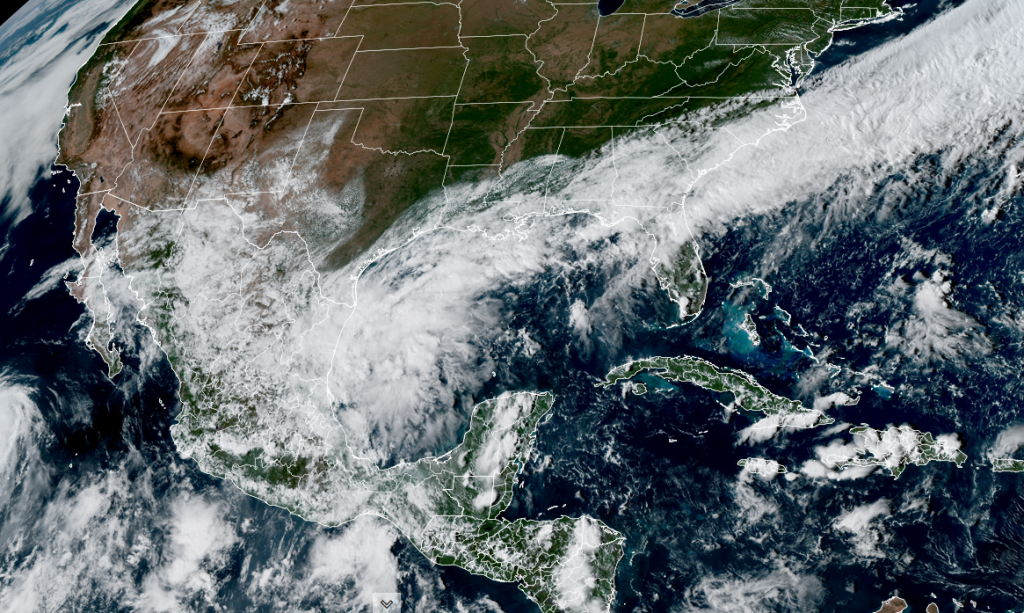
NOAA/Colorado State University/CIRA 10/05/2026 3:30 pm CDT
There is no closed low level circulation at the current time.
Although environmental conditions are currently only marginally conducive for tropical development, conditions are forecast to improve over the next few days and gradual development appears likely. NHC forecasters all for a tropical depression is to form over the southwestern Gulf sometime during the middle part of this week. The probability for development is at 80 percent.
After mid-week, the system is forecast to the north, with a track in the general direction of the U.S. Gulf coast, from Louisiana to the Florida Panhandle. With a ridge of high pressure building over Texas and a trough of low pressure tracking east across the southeastern U.S., the chances for this system to move toward Texas appear quite low.
Since this is still just an area of disturbed weather and not yet a tropical system, the National Hurricane Center is not issuing an official forecast track just yet. For guidance purposes, I do want to point out the Google Deepmind AI ensemble solution, one of the best performing tropical forecast solutions this year, is showing an increasingly tight clustering of track solutions in the general direction of the central and eastern Gulf coast for late this week and into the weekend.
For the Texas coast, elevated tides will be possible coast later this week as stronger northeasterly winds develop over the northwest Gulf. As of now, tides do not look to reach levels that would produce significant coastal flooding, but some minor flooding at times of high tide will be possible late week.
Weather conditions across the Hill Country, Central Texas, and the middle Texas coast look to stay sunny and dry through late week and the upcoming weekend as the developing tropical system pulls most of the available moisture well east Texas.
Bob
Periods of Rain Will Continue through the Weekend. Dry Weather Returns Monday
Key Messages
- Periods of light to moderate rain and isolated thunderstorms will continue across the region Friday night through Sunday
- Some of the most persistent rains on Saturday are forecast to occur across the Hill Country
- The coverage and intensity of the rain is expected to decrease Sunday
- The National Weather Service will allow the Flood Watch to expire at 7 pm Friday
- Additional rainfall Friday night through Sunday is forecast to average between 0.5 and 1.5 inches, with isolated totals to near 4 inches possible
- Sunny and dry weather will return Monday
Discussion
The weather pattern remains unsettled as we head into the weekend. A nearly stationary area of low pressure over the Texas Big Bend continues to draw considerable Gulf moisture inland across the state. A Pacific cold front was nearly parallel to Interstate 35 as of Friday afternoon, with the front slowly moving to the east. The front should finally push off the middle Texas coast sometime late Saturday. This feature is forecast to be the focus for shower and thunderstorm development Friday night and through the weekend. The front is expected to create an environment for the development of overrunning-type rains for areas located to the west of the boundary Saturday through Sunday.
For Friday night through Saturday night, expect periods of rain showers and isolated thunderstorms across the region. The probability for rain will be near 70 percent Friday night, 60 percent Saturday through Saturday night, and 40 percent Sunday. High resolution forecast data for Saturday leans toward the best chance for rain occurring across the Hill Country region, where the overrunning pattern will be the most pronounced. However, the exact placement of the precipitation remains somewhat uncertain.
Spotty rain showers will continue across the area on Sunday as the upper low over the Big Bend finally begins to shift to the south. Sunday’s rain isn’t expected to be as widespread or as persistent across the Hill Country and Central Texas regions as the rain that is forecast for Saturday. The coastal region is expected to see some widespread, moderate rain.
All the rain is predicted to decrease/dimmish Sunday night as the Big Bend upper low finally exits the region and a ridge of high pressure begins to spread over the state. Mostly sunny and dry weather is forecast Monday.
Additional rain amounts through Sunday night are forecast to generally average between 0.5 and 1.5 inches. However, some isolated pockets of 2-4 inches will be possible where the rain ends up being more persistent.
NWS Rainfall Forecast Valid 7 pm Friday through 7 pm Monday:
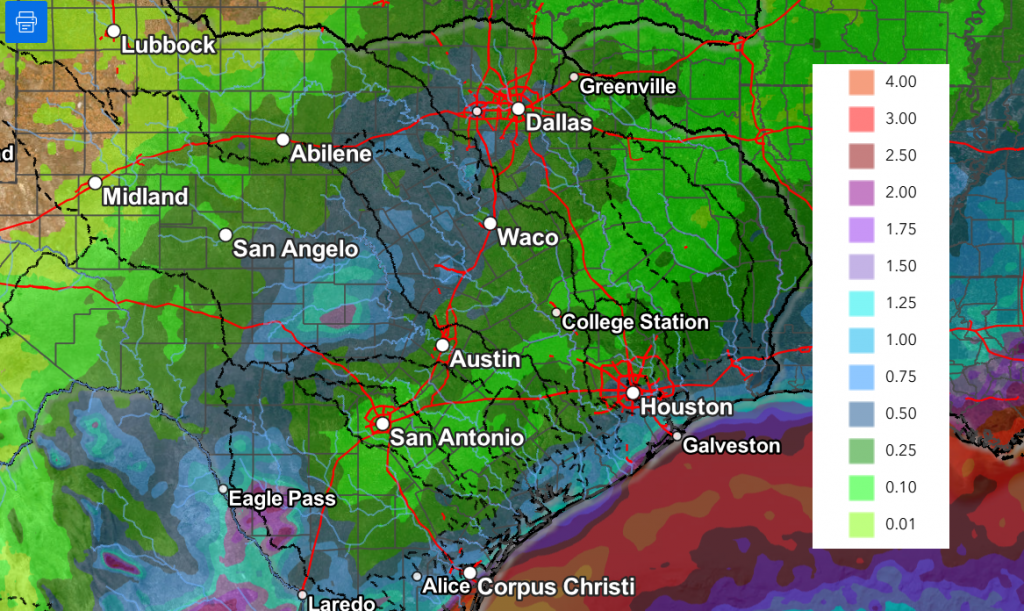
The outlook for next week calls for mostly sunny and dry weather as a ridge of high pressure spreads over Texas from the west. A dry cold front is forecast to spread south across the area Monday, bringing in drier air. High temperatures next week are forecast to be mostly in the mid and upper 80s. Low temperatures are predicted to fall to the upper 50s across the Hill Country, the low 60s across Central Texas, and the mid to upper 60s coastal zone.
Have a great weekend!
Bob
Wet Pattern Developing Thursday, Continuing through the Weekend
Wednesday’s forecast data continues to highlight the threat for heavy rain falling across the Hill Country and Central Texas regions late Wednesday night through midday Thursday, and for the coastal plains region late Thursday into Friday.
Wednesday’s analysis indicates the atmosphere over Texas had become quite moist and more unstable, compared to Tuesday. All eyes are on a trough of low pressure located over Arizona and New Mexico and its associated cold front. As of early afternoon, the front was located along the Texas/New Mexico border, extending southwest in to Far West Texas. The area along and just ahead of the cold front is expected to be the focus for the development of a large area of moderate to heavy rain when it pushes east from West Texas across the Hill Country and through Central Texas.
The cold front is expected to move very slowly to the east, causing the area of rain and thunderstorms to move slowly as well. Wednesday’s forecast solutions call for the cold front to reach the Concho Valley region Wednesday night, the Hill Country region Thursday morning, the Interstate 35 corridor Thursday night, and the coastal region on Friday.
- Showers and thunderstorms are forecast to develop ahead of and along the cold front across West Texas Wednesday night, then spread into the western Hill Country between midnight and 7 am Thursday
- The area of showers and storms are forecast to spread east across the eastern Hill Country and the Interstate 35 corridor early Thursday morning through early Thursday afternoon
- The area of rain and storms is forecast to move over the area between Smithville and Columbus early through late Thursday afternoon
Some of the rain within this area could be locally heavy, producing high totals in a short period of time. Behind the initial line of rain and storms, periods of light to moderate rain look to continue across the Hill Country and Central Texas regions Thursday afternoon through Thursday night. Periods of showers and thunderstorms are forecast across the middle Texas coast Thursday night into Friday morning.
Keep in mind some of the thunderstorms with this initial line could be strong to possibly severe. The Storm Prediction Center has placed the Hill Country and Central Texas regions under a 1 out of 5 risk for severe storms through Thursday night. Severe weather threats will include large hail, damaging downburst winds, and an isolated tornado or two.
For Friday, periods of moderate rain and a few isolated thunderstorms are forecast across the region as a piece of the upper trough hangs back across the southern Rockies. The probability for rain Friday will be near 90 percent, decreasing to 70 percent Friday night.
The National Weather Service has posted a Flood Watch for the Hill Country and Central Texas regions through Friday evening.
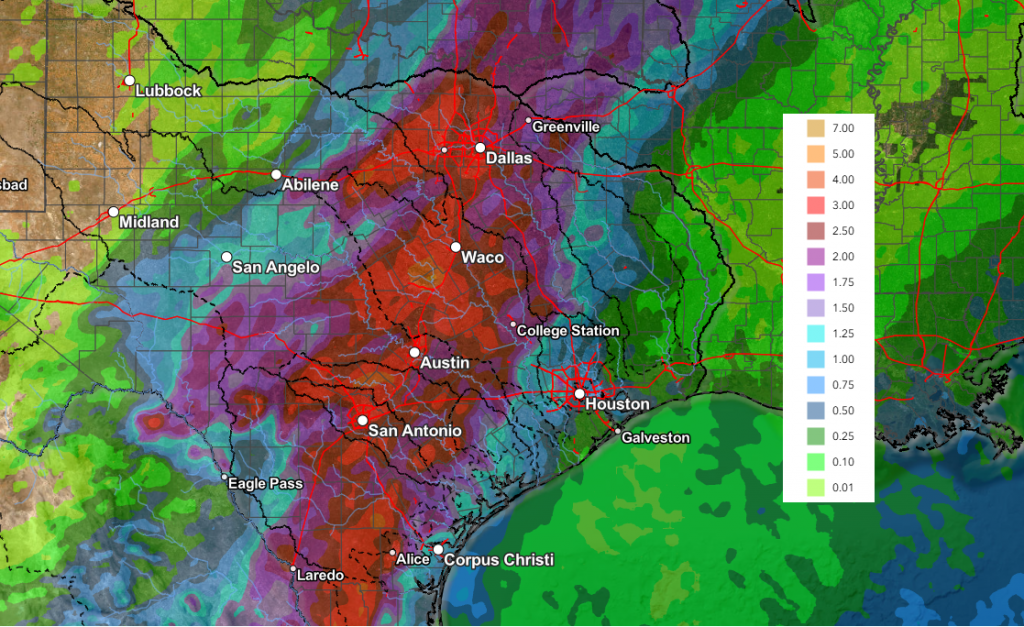
Rain amounts through 7 pm Friday across the Hill Country and Central Texas regions are forecast to generally average between 1 and 4 inches, with isolated totals of 6-8 inches possible. For the coastal region, totals of 1-3 inches are forecast.
NWS Rainfall Forecast Valid through 7 pm Friday:
Saturday through Sunday, periods of light to moderate rain are forecast as an overrunning pattern sets up across the region. The probability for rain both days looks to be near 50-60 percent. Additional rain amounts of 0.5 to 1 inch are predicted through Sunday. The chance for rain is forecast to diminish on Monday, with sunny and dry weather following for the remainder of next week.
High temperatures this weekend through late next week are forecast to mainly be in the low and mid-80s, with lows in the upper 60s.
Bob
Monitoring the Threat for Heavy Rain Thursday and Friday
Tuesday’s forecast solutions are not showing any significant changes compared to what was shown on Monday. A large area of slow-moving showers and thunderstorms is forecast to spread across the region late Wednesday night through Friday, with additional lighter rains lingering Saturday into Sunday. Significant totals of rain are forecast over the next few days—especially across the Hill Country and the Interstate 35 corridor. The heavy rain will increase the threat for flash flooding across the area.
A strong trough a of low pressure pushing east out the Desert Southwest, a slow-moving cold front, and very high amounts of Gulf and Pacific moisture and are all forecast to come together across Texas beginning late Wednesday, resulting in the development widespread, moderate to heavy rain. Forecasters will be closely monitoring the progress of this cold front as the heaviest rains are forecast to develop ahead of and along the front. The front will be moving slowly, entering the western Hill Country early Thursday morning. The boundary is forecast to push east across the Hill Country during the day, reaching the Interstate 35 corridor sometime Thursday evening and the coastal plains region Friday morning into Friday afternoon.
High-resolution forecasts call for a large area of showers and thunderstorms to develop across the Concho Valley and the Rio Grande Plains Wednesday night, with the area of rain spreading east into the Hill Country early Thursday morning. The area of rain is forecast to slowly spread east to the Interstate 35 corridor Thursday into Thursday night and the coastal plains region Thursday night into Friday morning. Lighter rains are forecast across the Hill Country on Friday.
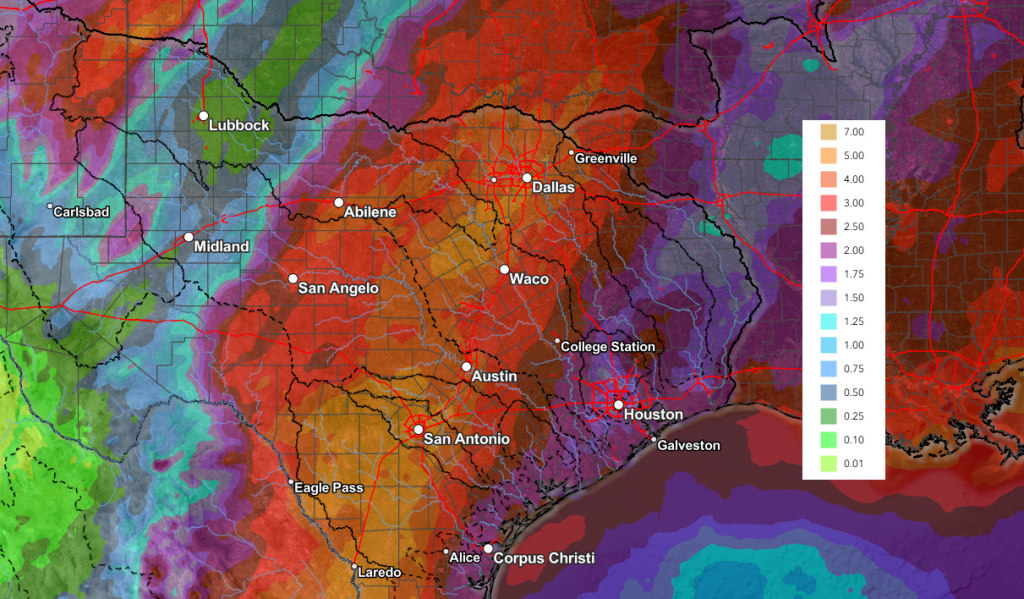
Rain amounts from Wednesday night through Friday evening are forecast to generally average between 2 and 4 inches across the region, with isolated totals of 6 to 8 inches possible. The National Weather Service has posted a Flood Watch for the Hill Country and Central Texas regions from Wednesday evening through Friday evening.
National Weather Service Rainfall Forecast Valid through 7 pm Sunday:
Forecasts continue to show a low-end chance for some of the thunderstorms to be strong to severe Wednesday night through Thursday. SPC forecasters have placed the Hill Country and Central Texas under a 1 out of 5 risk for severe thunderstorms through Thursday night. Large hail and damaging winds look to be the greatest severe threats.
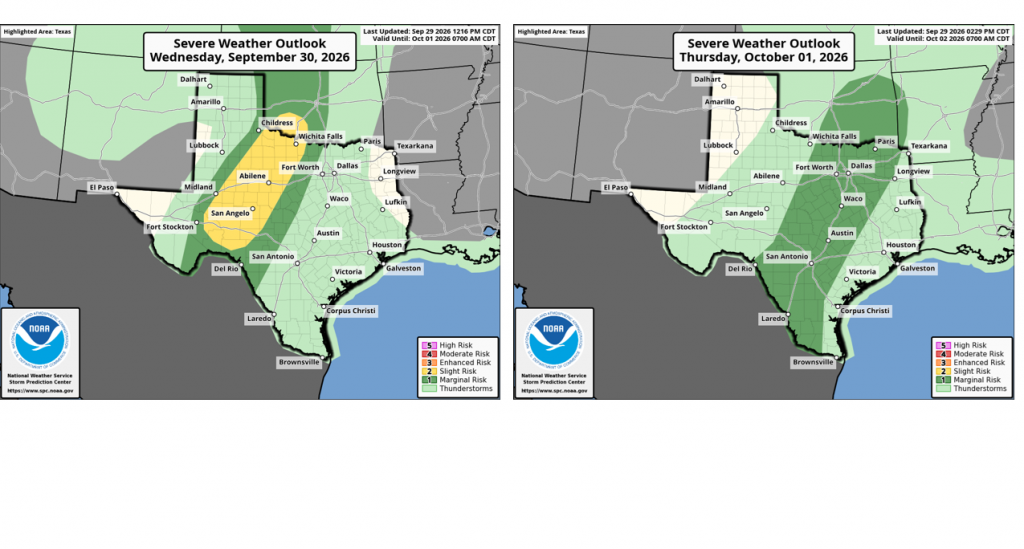
A second trough of low pressure developing over northern Mexico on Friday is expected to keep a chance for rain going through the weekend. This rain is not expected to be nearly as heavy as what is forecast for Thursday and Friday. Periods of light to moderate rain are forecast. The probability for rain will be near 70 percent Saturday, 60 percent Sunday, and 20 percent on Monday. Sunny and dry weather is forecast next Tuesday through Friday.
High temperatures look to trend a little cooler behind this week’s cold front. High temperatures Friday through Sunday are predicted to generally be in the low 80s, with lows in the upper 60s. Similar readings are expected for next week.
Bob
Moderate to Heavy Rains Expected to Develop Late Wednesday through Friday
Significant changes in the weather will take place this week that are expected to cause periods of widespread, heavy rain and possible flooding across the region Wednesday through Friday. This weather change is also expected to finally put an end to the persistent summer-like temperatures we’ve had in place since August.
Monday afternoon through Tuesday night, the weather is expected to stay generally dry and quiet across the region. A few isolated rain showers and thunderstorms will be possible across the western Hill Country and the middle Texas coast Monday and Tuesday afternoons. However, rain amounts, if any, should average less than a quarter inch. In general, expect a mostly sunny to partly cloudy sky with high temperatures in the mid and upper 90s. Southerly breezes are forecast to increase to 10-15 mph with occasional gusts to 25 mph on Tuesday.
Starting Wednesday, ingredients appear to be coming together that will have the potential to bring periods of heavy rain and potential flash flooding to our region. Forecasters are closely monitoring a Pacific trough of low pressure that is currently pushing inland over California. This trough is predicted to track east this week, finally moving the persistent heat dome away from Texas. Forecasters will also be following the progress of Major Pacific Hurricane Polo that should make landfall along the coast of Baja, California Monday evening and the northwestern Mexican mainland Tuesday morning. Polo’s remnants are expected to merge with the approaching Pacific trough as it moves across the southern Plains. By Wednesday morning, the combination of strong atmospheric lift ahead of the trough, Polo’s remnant mid and high-level moisture, and significant moisture streaming inland from the Gulf will create a very moist and unstable atmosphere across much of the state.
One additional key feature that will play an important role in determining the location of this week’s widespread rains will be a Pacific cold front tied to the upper trough. The heaviest rains are forecast to develop just ahead of an along the cold front. Forecasts call for the cold front to move into West Texas on Wednesday, then slowly push east to the Hill Country on Thursday, reaching the Interstate 35 corridor sometime late Thursday into Thursday night. The front is forecast to slowly track southeast towards the coast on Friday. Confidence in the timing of the cold front is not all that high at this point. The front may end up moving a slower than is currently predicted above.
Scattered rain showers and thunderstorms are forecast to increase across the area Wednesday as the atmosphere grows increasingly moist and unstable. A southwest to northeast oriented band of moderate to heavy rain is forecast to develop Wednesday night across the Edwards Plateau, with the area of rain slowly spreading east across the Hill Country Thursday, reaching the Austin/Interstate 35 corridor late Thursday, and the area from La Grange south to the coast Thursday night into Friday morning. Periods of lighter rain and scattered thunderstorms are forecast to continue across the region Friday through Sunday as the trough slowly tracks to the east.
The National Weather Service’s Daily Forecast for Rain:
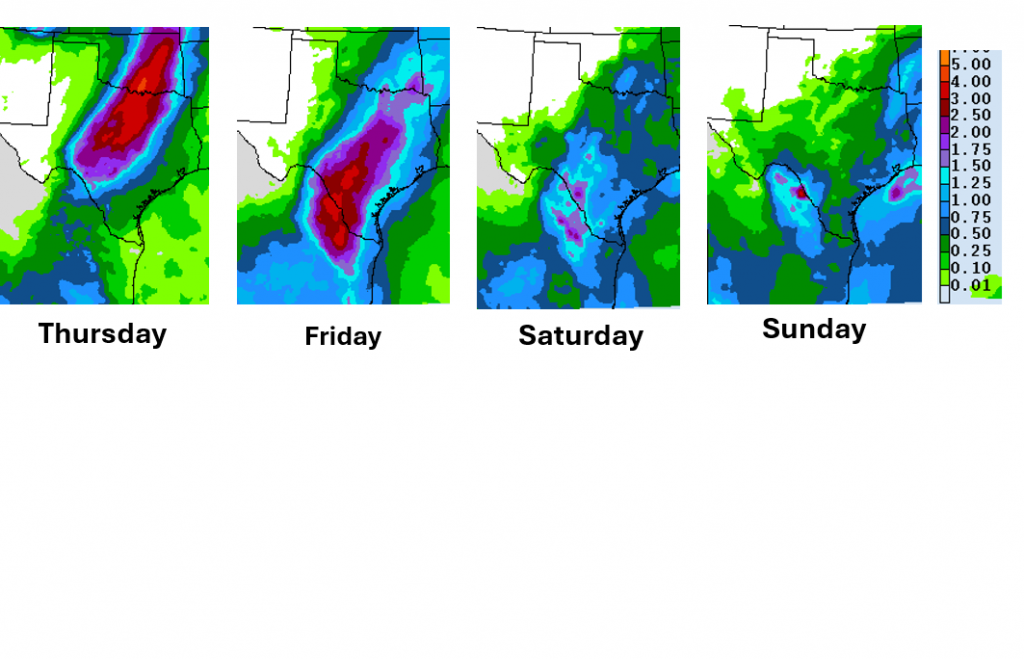
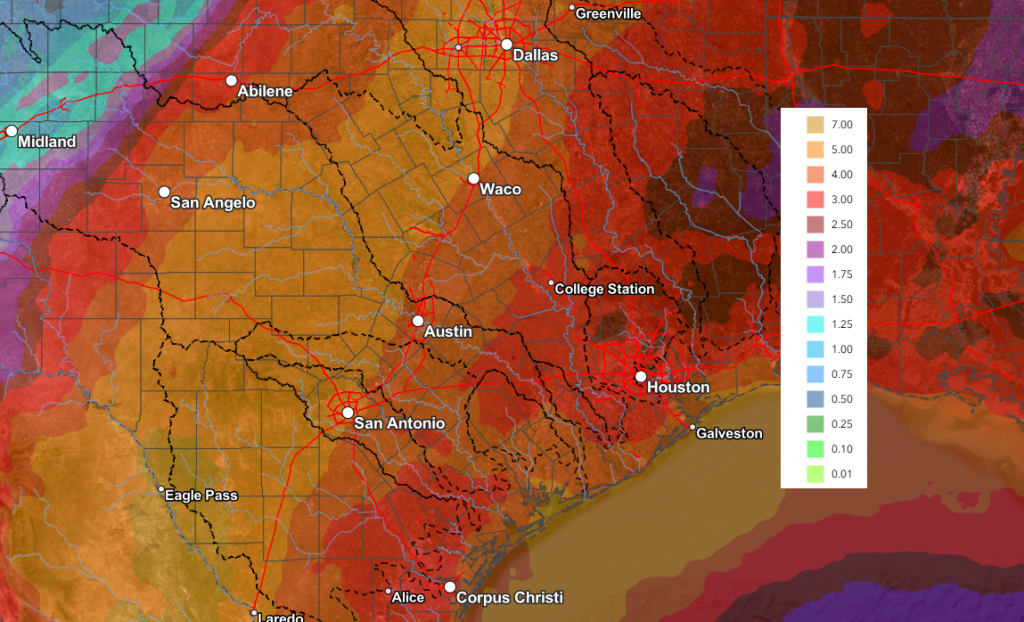
Rainfall forecasts call for the heaviest rains to occur Wednesday night through Friday, with lighter rains continuing through the weekend. Total rain amounts through weekend are forecast to generally average between 4 and 7 inches across the Hill Country, and between 4 and 6 inches for most other locations. Some isolated heavier totals will also be possible. The forecast totals could go a little higher or lower as we get closer to the rain event.
NWS Rainfall Forecast Valid through 6 pm next Monday, 10/5
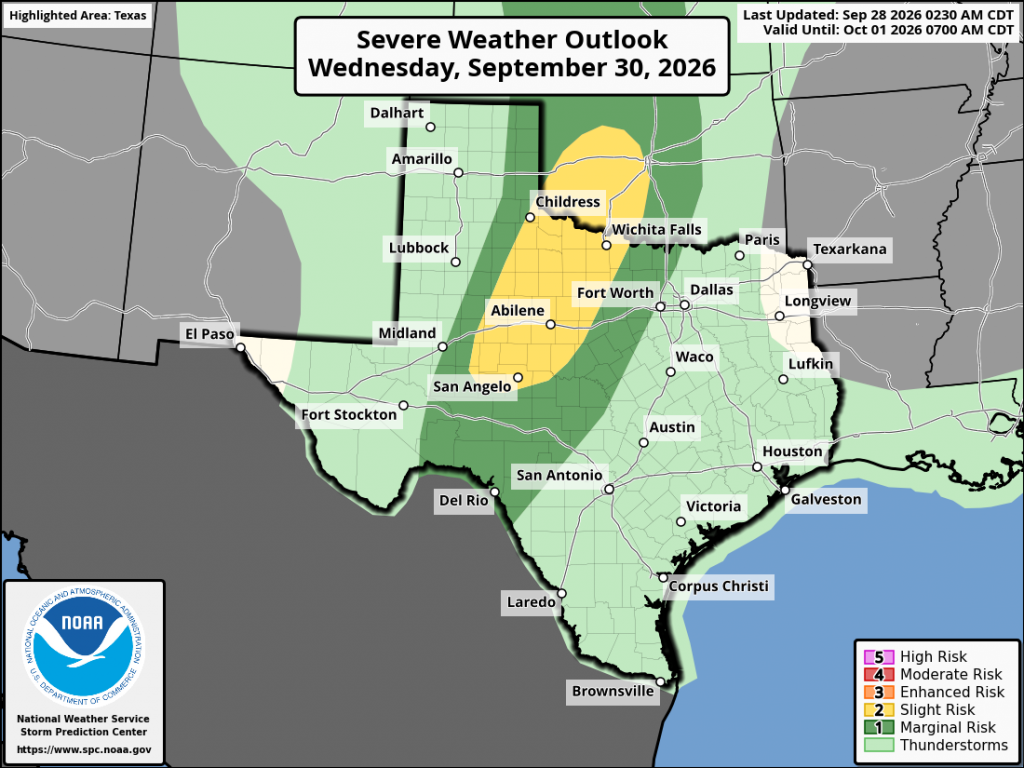
One additional item to note about the rain event, some of the storms moving across West Texas and the northern Hill Country Wednesday could be strong to severe. The Storm Prediction Center has placed this area under a Marginal to Slight Risk for severe thunderstorms. Large hail and damaging winds will be the greatest severe weather threats.
Temperatures are predicted to trend lower beginning Thursday due to the widespread clouds and rain. Expect highs in the mid-80s to 90 degrees. Slightly cooler air will filter in behind the front Friday and through the weekend, with highs generally in the low and mid-80s, with lows in the upper 60s to low 70s.
The outlook for next week calls for mostly sunny and dry weather. Expect high temperatures to be in the mid and upper 80s, with lows in the 60s.
Bob
Social Media